

Two miles northwest of Wymondham sits the residential development of St Georges. This was formerly the site of the Wicklewood Workhouse. Under its official title of the Forehoe House of Industry (later the Forehoe Institution), the workhouse took in the poor from Wicklewood as well as from ten neighbouring parishes from c1776 until 1930.
In 1927, to commemorate the Institution's 150th anniversary, its Guardians placed a white marble memorial cross within the Institution’s burial ground situated on its northern edge, between the main building and the road. Its inscription reads, ‘This enclosure was formerly the burial ground for the Institution. In memory of those who are buried therein, the Forehoe Guardians placed this stone MCMXXVII.
During the intervening 98 years, the cross has had a hard life. Around 35 years ago, when the buildings were converted into a residential development, the burial ground was separated from the main site. This meant the memorial cross had to be re-sited in the curtilage of St Georges. Although the developers chose a site backing onto the burial ground, the cross no longer stands in the reverential shade of old trees; now it has the communal washing lines, gas tanks and the back of a garage block as its companions. Worse still, during the redevelopment, the cross was severely damaged, knocked over and broken into three sections. Poorly repaired, the cross was a sorry sight; its marble, once white, was badly soiled and dirty, and its inscription was no longer legible.
Still, although shoddy and unkept, the memorial cross has always been an integral part of both Wicklewood's heritage and the broader area that made up the former Carleton Forehoe Hundred. Throughout its long existence, when it ministered to the poor, many people passed through the workhouse’s doors, some of whom died here. Today, not only do local residents and those from nearby counties have relatives buried here, but also people from across the world. This year, people from England, the USA and Australia have come to St Georges looking for information about their relatives who were born, lived, or died at the workhouse during the nineteenth century.
The cross, therefore, is both a permanent reminder of South Norfolk's past and a memorial to its poor. So, action was clearly needed to restore it before it was too late. With the aid of a generous grant, facilitated by Richard Elliott, the South Norfolk District Councillor, a bequest from the Wicklewood Old Village Hall Charity Trust, and two private donations, the cross has been professionally repaired, cleaned, and the stonework touched up. To separate the cross from its surroundings and give it dignity, a small hedge has been planted around it. Rosemary was chosen for this because it is not only hardy, drought-resistant, and fragrant, but also symbolises remembrance, especially of the departed. A black granite plaque was commissioned and placed on the ground in front of the cross. Its inscription reads, ‘This cross was refurbished in 2025 by those who have not forgotten former residents buried nearby.’
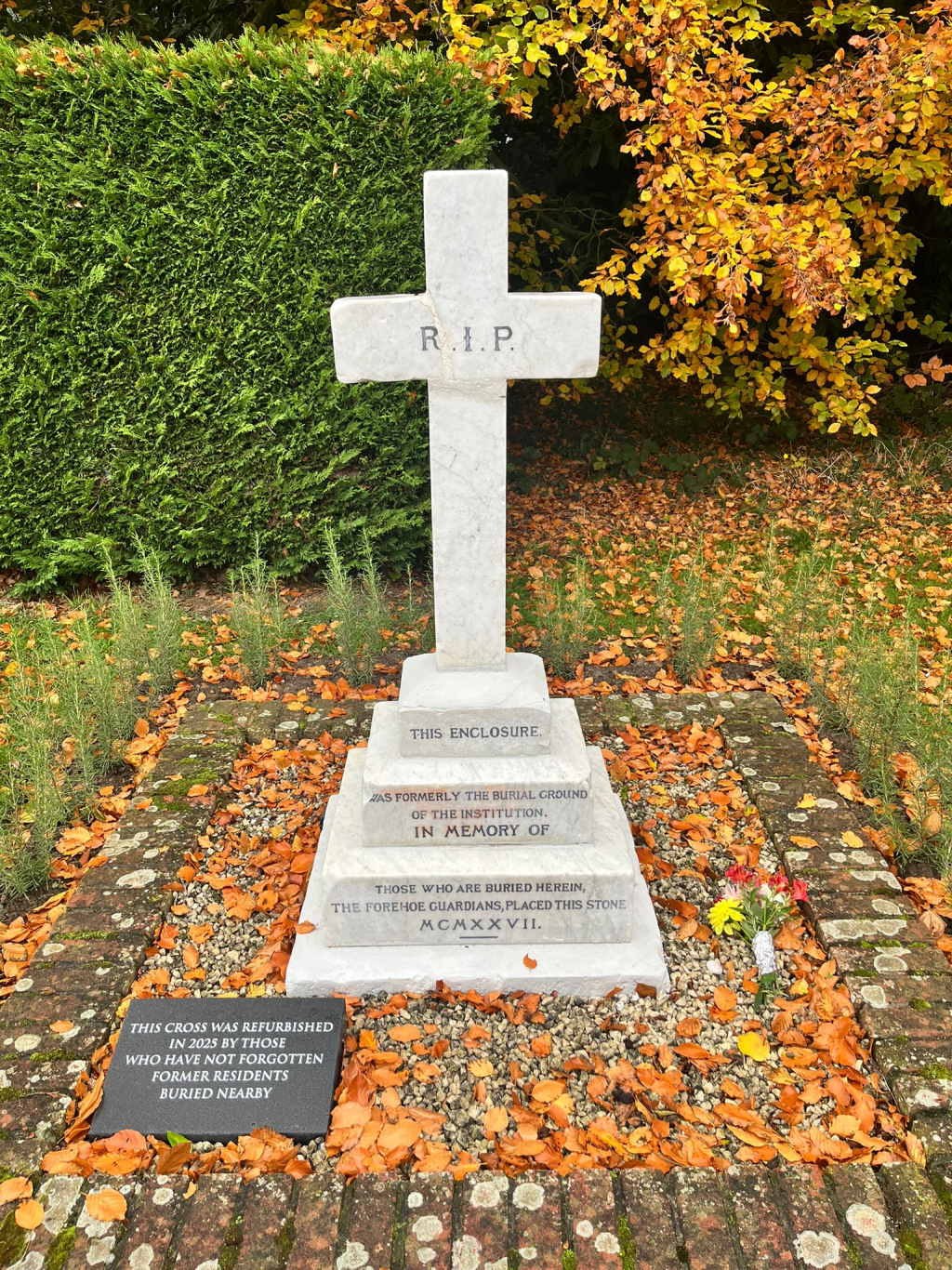
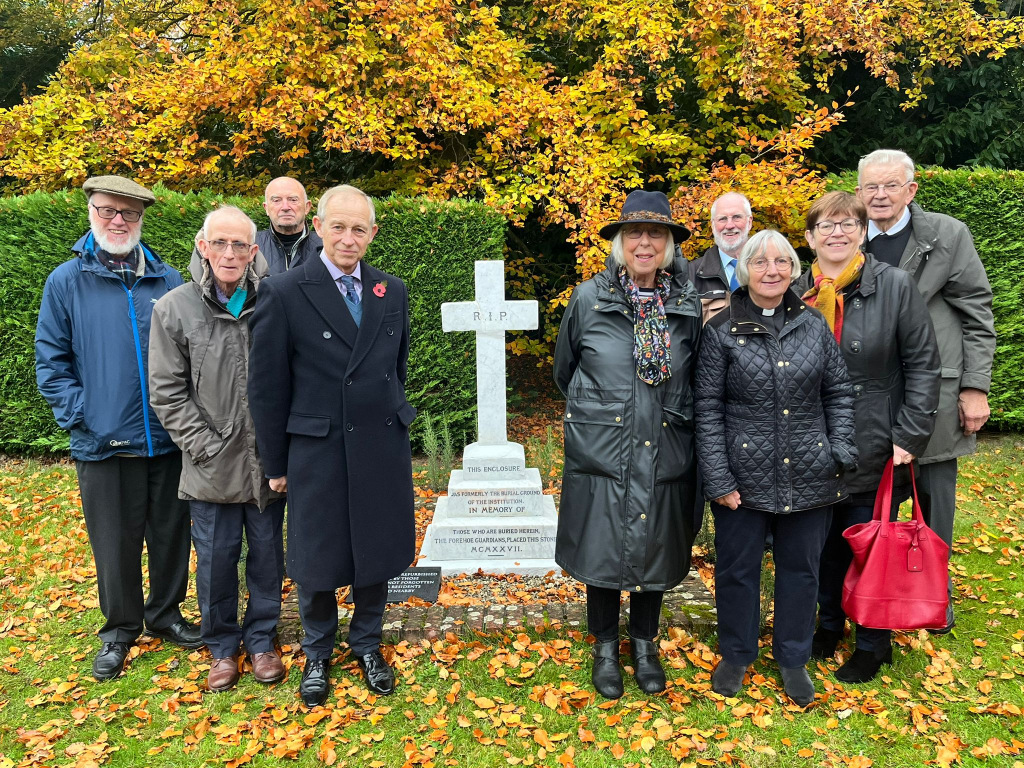
As the Institution’s Guardians had held a dedication service at the erection of the cross in December 1927, those involved in the cross’s refurbishment decided it would be appropriate to rededicate the cross. On Wednesday, 29th October 2025, in front of the newly restored cross, gleaming white against its autumnal backdrop, over 50 people attended a short service. These included those directly involved in funding the refurbishment, residents from St Georges, and invited villagers from Wicklewood and the surrounding area. Hilary Matthews, one of those who live at St Georges, began proceedings.
After a summary of the site’s history, she outlined why the restoration of the cross was necessary, a theme that Richard Elliot, the South Norfolk District Councillor, expanded upon. Then Trisha Brookes recounted the harrowing story of a heavily pregnant family member, who in 1841 sought help from the workhouse but was denied it. Unfortunately, she died days later, and her newborn young son, though he was admitted, died at the workhouse two months later.
After this sobering account, the Revd. Shirley Holt led prayers before re-dedicating the cross. Hilary Matthews then read Charles Baudelaire’s thought-provoking poem La Mort des Pauvres (Death of the Poor), before the Revd. Shirley Holt read a closing prayer. The weather, although threatening rain, stayed dry throughout the service.
After the service, well over 40 squeezed into The Lodge for tea, cakes, and the opportunity to browse photos and documents about the workhouse, the burial ground, and the cross. Included amongst these, and hot off the press, was the latest book by local historians Mary and Terry Miller: ‘Wicklewood and Crownthorpe: A Step into the Past’. It was a memorable afternoon and enjoyed by all.