

Social media has been in uproar about a decision by Norfolk County Council to remove Pride displays from the county’s libraries.
It all started when the council, now led by Reform UK, revealed that it had banned political messaging and displays – including Pride displays – from the county’s 47 libraries. The story got out, and as you can imagine, the reaction was swift. Critics of this decision included two well-known Wymondham names.
Ben Goldsborough, MP for South Norfolk (including Wymondham), put out a Facebook statement condemning the guidance as ‘shameful, divisive, and deeply damaging’. Then Wymondham councillor Suzanne Nuri-Nixon wrote the following as a comment on Goldsborough’s post:
‘Thin end of the wedge. Today LGBT+ communities. Next book banning? Book burning? Other minorities being targeted? Elected representatives are meant to serve all sections of the community not discriminate. Reform are not your friends and are not the answer.’
Goldsborough responded to this by saying, ‘if only I could give you a million likes for this!’
Certainly, if it were a choice between Reform UK or Ben Goldsborough, I would choose Goldsborough every time. At the time of writing, a Reform councillor is being investigated for a grossly offensive tweet about Nigerians, their policies are questionable (to put it mildly), and their leader is standing in a by-election against a talking bin. Goldsborough, on the other hand, is a dedicated MP whose compassion and decency I can personally vouch for, having met him twice. And I will admit that part of me does have reservations about the council’s decision. If you are looking for books on LGBT topics, especially if it’s topical (like during Pride Month), it seems legitimate to have a display dedicated to that topic in the same way you’d have a Christmas display or a History section. To clamp down on this does feel like an unnecessary restriction on curatorial freedom.
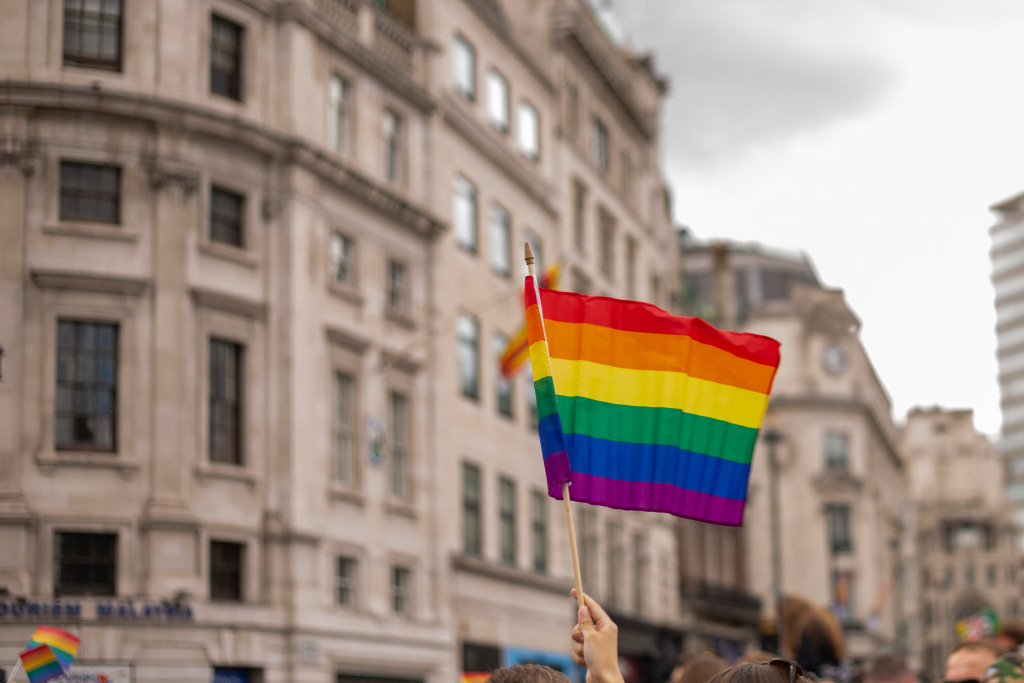
You could also argue that the decision is mean-spirited, if nothing else. I’ve been in bookshops with Pride flags flown outside, and it is always done with good intentions. People fly it to signal their support of gay people, so again, one understands why the decision feels harsh to some.
But this decision does not justify the alarmism. This is not the ‘thin end of the wedge’ towards book burning. At all. (Indeed, if people are worried about book burning, a memorable instance from recent years was when trans rights activists took to social media to burn copies of J.K. Rowling’s books. This always struck me as completely stupid because it suggests that queer activism is violent and intolerant, arguably doing far more damage to the cause than the removal of a flag.)
At the time of writing, no news report has said that the books themselves have been banned from libraries. Nor have gay people been banned – that would justify the online outcry (and it would be illegal). Gay people can still walk into libraries and read gay books and are legally and socially entitled to do so without justifying themselves. As it should be in any free country. This decision doesn’t change any of that.
Another commentator (outside Wymondham) said that removing Pride displays ‘sends a message that certain people aren’t welcome in public spaces’ – of course it doesn’t. I don’t need a flag to give me permission to enter a library, and nor do most of the gay people that I know. This well-intentioned outcry imposes a victimhood mentality on people: that no one can possibly enter public spaces unless a flag signalling their legal rights is flown outside. That is ludicrous. It underestimates people’s resilience. Believe me – nothing stops me entering a library if a book I want is inside.
Additionally, there are good-faith reasons for agreeing with the decision (remember: they did not exclusively ban Pride displays, but displays of any political nature). In an ideal world, Pride would be an apolitical symbol for gay acceptance, but unfortunately today that is not the case. For many people, Pride today has become a symbol of bullying, ostracism, and political ideas far more contestable than support for gay rights. See the Jo Phoenix tribunal, for instance, where a female academic (Dr Phoenix) was unlawfully harassed, discriminated against, called transphobic and compared to a ‘racist uncle’ for her gender-critical views. I have been in Pride-positive spaces where people talk about gender-critical perspectives as if they are Nazi-adjacent, when in reality they are perfectly lawful and often (ironically) espoused by gay people, including Phoenix who is herself a lesbian.
Bottom line: Pride these days is not apolitical. It has become political for its contestable ideas and reputation for toxic harassment of opposing opinions (there are countless similar cases). In this context, you could argue that a publicly funded and politically neutral library shouldn’t have a Pride flag displayed any more than it should have flags bearing ‘Vote Farage’ or ‘Vote Trump’.
My aim here is not to privilege either view – the point is, this is not a Stasi-like suppression of gay people. It is a dispute with plausible justifications on both sides, and one that in any case does not adversely affect anyone’s ability to participate in public life. The day Reform UK ban gay literature from these spaces, or the day they illegally prevent gay people from entering, that is the day I’ll be marching with Goldsborough.
Until then, I’ll be in the library.